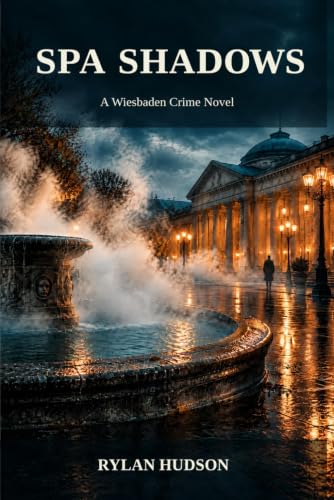
Spa Shadows begins with an image that refuses to stay still: steam rising from the Kochbrunnen while a city continues its evening rituals around a dead man.
That contrast is the novel’s first central tension. Wiesbaden is known through surfaces – spa architecture, gold-lit windows, public elegance – but a crime story asks what those surfaces conceal. The city becomes an active presence: not a postcard, but a system of routes, rooms, records and silences.
The setting as a second detective
In the world of Spa Shadows, location carries evidence. The Kochbrunnen provides the opening image; the casino and Kurhaus widen the field; sealed rooms and missing files turn the city’s history into an investigative language. Every place suggests a question: who was allowed inside, who was kept outside, and who benefits when a door remains closed?
This approach gives the novel its particular atmosphere. The movement is not only from clue to clue, but from surface to depth. Public spaces carry private histories. A polished façade can be a form of protection. A small key can become a threat because it points toward a room that someone wanted forgotten.
The core question
What happens when a city’s polished present is forced to answer for the decisions it buried in the past?
Why the past reaches back to 1998
The reference to 1998 creates a deliberate temporal pressure. The investigation is contemporary, but its meaning cannot be contained in the present. Missing files, sealed rooms and old decisions suggest that memory is not passive: it can be curated, redirected and defended.
That is where the crime plot meets the novel’s deeper interest in power and silence. A secret does not need to be spectacular to shape the lives around it. Sometimes it survives through ordinary habits – a document left unfiled, a name avoided, a room nobody discusses.
René Neudt and the discipline of attention
Chief Inspector René Neudt enters the story through observation. His work is not simply to identify a culprit; it is to notice the relationships between objects, people and places. The casino receipt, the key marked Room Twelve and the missing records become meaningful because he refuses to treat them as isolated details.
Together with Jan Bandtke, he follows a trail that keeps changing scale. One moment is intimate – a body, a key, a decision. The next is civic – an institution, a district, a history that has outlived the people who first tried to control it. The partnership gives the investigation a human rhythm while the city supplies the pressure.
Bringing the English edition to a wider readership
The English edition preserves the essential geography of the story while opening its atmosphere to readers beyond the German-language market. Wiesbaden remains specific – Kochbrunnen, Kurhaus, casino – yet the questions are widely legible: how does power protect itself, what does loyalty cost, and can truth arrive before a place has rewritten its own history?
That balance is central to the book’s appeal. Spa Shadows is rooted in one city, but it is not limited to one city. Its tension comes from the meeting point between a precise place and a universal fear: that the past may still be waiting beneath the surface.
Continue exploring
Enter the world of Spa Shadows.
Read the spoiler-free preview, browse the confirmed edition details and follow the official path to the book.